Wayland officials are weighing a contested zoning amendment that would increase building height and residential density in the Route 20 West overlay district, exposing a dispute over how the town should balance state housing compliance, development feasibility and local design control.
The zoning debate centers on Town Meeting Article 25, proposed by the Planning Board, which would raise the maximum building height in the Route 20 West subdistrict from 35 feet to 58 feet and increase allowable density from 20 to 32 units per acre.
The Planning Board had held its required public hearing on the amendment Jan. 7, 2026, with no public comments recorded. The amendment is intended to align zoning with current financial realities for multifamily development and ensure the district can support viable projects under the state’s MBTA Communities Act.
At an April 8 Economic Development Advisory Committee meeting members challenged whether the proposed increases, without additional constraints, could lead to buildings that are out of scale with the surrounding corridor. The Planning Board authorized two members to come to discuss the background of the Article and state law regulatory process constraints that are imposed on zoning proposals.
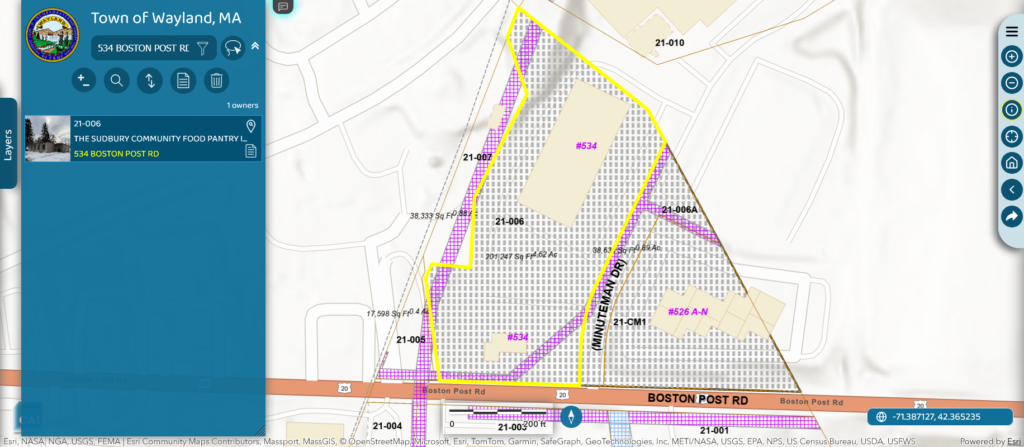
The Route 20 West Sub-district, located near the Sudbury town line and anchored by parcels along Minuteman Drive before the Longfellow Sports Club, was created as part of the town’s 2024 MBTA zoning compliance plan, which voters approved with roughly 65% support.
Planning Board Chair Anette Lewis and Vice Chair Robin Borgestedt defended the amendment as a narrowly tailored adjustment necessary to make development financially feasible. Borgestedt said that under current zoning, small projects are unlikely to proceed because developers cannot achieve sufficient returns, effectively undermining the intent of the district.
The EDC, led by Chair Rebecca Stanizzi, did not dispute the need for additional housing or increased density but argued that the bylaw should include stronger safeguards on building form and placement. Stanizzi warned that the proposed changes could allow a “reasonable worst case” scenario in which a five-story or taller building, potentially with exposed parking at its base, could be constructed 15 feet from Route 20, creating what she described as an “overwhelming” visual impact along a primary gateway into town.
The disagreement quickly focused on whether design controls — such as increased setbacks, step-backs in upper floors, or limits on massing — should be written directly into the zoning bylaw or handled later through Planning Board regulations.
Lewis and Borgestedt strongly advocated for keeping the bylaw limited to height and density changes, with design elements addressed through regulations. They argued that regulations offer flexibility and can be updated without Town Meeting approval, while changes to the bylaw would likely trigger additional state review.
Town Planner Robert Hummel reinforced that position, cautioning that expanding the scope of the amendment could jeopardize compliance with the MBTA Communities Act. He said the existing zoning framework was developed over two years with state-approved modeling and warned that altering dimensional requirements beyond the proposed increases could require the town to re-run technical analyses demonstrating that the district can still meet required housing capacity.
“We don’t want to introduce complexity that could delay or invalidate it,” Hummel said, emphasizing the need to move forward with a compliant plan.
Lewis echoed that concern, noting that the state requires municipalities to maintain zoning districts capable of producing a specified number of housing units. She said that modifying key parameters without revalidation could lead to rejection by the Executive Office of Housing and Livable Communities or the Attorney General, potentially putting the town’s compliance status — and access to certain state funding — at risk.
“We had two grants totaling $49,000 from the state to do the modeling,” Lewis said. “As you start changing certain parameters, you can’t just do it. You have to be able to prove that you’re producing the same number of units.”
EDC members remained skeptical that regulations alone would provide sufficient protection. They raised concerns that overly restrictive regulations could be challenged by developers if they are seen as undermining the “as-of-right” nature of MBTA zoning, potentially allowing projects to default to the maximum height and density permitted under the bylaw.
Stanizzi spoke about how for Alta Oxbow, the town created zoning that called for various different height limitations at certain distances back from Route 20. Lewis emphasized the difference between the Route 20 West parcels and the Alta Oxbow development, explaining that Alta Oxbow was built on town-owned land, allowing officials to impose design conditions through a controlled process but that the Route 20 West subdistrict consists of privately owned parcels where such leverage may not exist.
The physical constraints of the subdistrict also factored into the discussion. One parcel at 534 Boston Post Road is heavily encumbered by gas and water utility easements, limiting buildable area, while another at 526 Boston Post Road sits approximately 25 feet below the grade of Route 20. While a constraint on how close any development could be to the roadway without undermining Route 20, the topography also potentially reduces the perceived height of buildings from the roadway.
Despite these constraints, EDC members argued that the bylaw should establish clearer, predictable limits to guide development outcomes. Stanizzi said she supports increased density but wants to ensure that buildings do not exceed a scale consistent with community expectations.
Other participants framed the issue in terms of economic necessity. Stanizzi and others noted that developers typically require a certain number of units — she estimated at at least 75 but more like 150 — to make projects financially viable. Stanizzi added that allowing greater height could actually improve outcomes by enabling higher-quality construction rather than forcing cost-cutting measures.
The meeting also highlighted tensions over governance roles. Lewis pushed back
“It’s not the EDC’s function to tell the Planning Board, or any other board, how to do things,” Lewis said. “We’re happy to listen to your advice, and we think that for the things that you’re talking about, they can be worked out in the regulations.”
The discussion grew more contentious at times, including an exchange in which EDC member Jeff Vecchio questioned whether the town should push forward with changes regardless of potential state objections, arguing that local priorities should take precedence. Borgestedt responded that the risk of losing compliance — and associated funding — made that approach impractical.
Additional tension arose when Vecchio suggested a potential conflict of interest involving a Planning Board member, a claim that he did not substantiate during the meeting. Both Lewis and Hummel had reiterated that no formal development proposal had been submitted for the Sub-district to the Planning Board.
Early-stage discussions between property owners and the town planner are typically confidential. Lewis affirmed that one of the parcel owners had asked the Planning board at the time to be included in the new Sub-district, to which the Planning board had agreed.
By the end of the meeting, board members agreed to continue to explore whether revised language or supplementary regulations could address EDC concerns without jeopardizing state approval.
Lewis outlined the multi-step process for amending zoning bylaw and town regulations. She indicated that the Planning Board would consider alternative language if it meets legal and regulatory requirements.