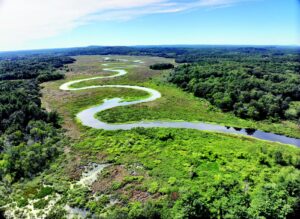
Sherman’s Bridge Road petition articles before Town Meeting all come from the same concern. Residents say the narrow, winding 0.7-mile road has become less safe due to speeding, truck traffic, limited sightlines, the lack of sidewalks or bike lanes, and the mix of pedestrians, cyclists, children, and older residents using or living along the corridor.
The three articles differ in remedy but share a practical problem: even if Town Meeting approves them, most requested changes cannot be made by Wayland alone.
Article 26 asks Town Meeting to support a ban on heavy commercial vehicles on Sherman’s Bridge Road. Petitioners argue that truck traffic has used the road as a cut-through since weight-limit signs were removed during a Route 117 construction project in the late 1990s. They say reducing truck use would improve safety, reduce noise and wear, and better protect a scenic residential road.
But the Finance Committee states that Wayland cannot impose such a restriction on its own. Sherman’s Bridge Road connects Wayland and Sudbury, so any heavy commercial vehicle restriction needs approval from the Massachusetts Department of Transportation and coordination with Sudbury. The committee also says MassDOT has indicated it would not support a weight-based or heavy commercial vehicle exclusion.
Article 27 goes further, proposing a permanent five-ton weight limit and a 20 mph safety zone near the bridge. Supporters present the five-ton limit as a compromise. It would allow ordinary passenger traffic while reducing bridge stress and discouraging heavier cut-through vehicles.
The practical and legal obstacles are sharper here. The Finance Committee says a five-ton limit would bar many trucks, as well as school buses, fire engines, construction equipment, agricultural machinery, and heavily loaded pickups. It also notes that weight limits must follow structural load ratings under state and federal inspection rules, not just neighborhood preferences or traffic-calming goals. As with Article 26, the committee says Wayland lacks unilateral authority. Sudbury has not signaled support. MassDOT has indicated it would not support a bridge weight restriction.
Article 28 focuses less on truck exclusion and more on direct traffic-calming measures, including a 20 mph speed limit, a crosswalk, and expanded signage warning drivers about limited sightlines, driveways, wildlife, a bus stop, and vulnerable road users. Of the three, this article is the most closely tied to conventional roadway safety measures. But it faces a similar implementation problem.
The Finance Committee says a lower speed limit would still need to fit within MassDOT-approved frameworks, such as a special speed regulation based on a traffic study, a school zone, or a statutory safety zone. The committee says Sherman’s Bridge Road is not a school zone, Wayland has not adopted the provisions needed for a safety zone, and a fall 2025 traffic study produced inconclusive support for lowering the current 25 mph limit. A second study was underway in spring 2026, and some signage and crosswalk questions were already being reviewed through that process, apart from the petition article.
Taken together, the three articles are less a set of immediately executable traffic orders than a referendum on how strongly Town Meeting wants the Select Board to keep pressing the issue.
The main policy divide is straightforward. Supporters argue that the road’s geometry, residential character, and vulnerable users justify strong intervention to reduce speed, truck traffic, and perceived danger. Opponents do not necessarily dispute residents’ frustration, but argue that the requested solutions either exceed Wayland’s legal authority, conflict with state standards, risk blocking essential vehicles, or should wait for traffic-study results and a broader townwide traffic-safety process.
The central issue is not just safety on Sherman’s Bridge Road. The question is whether Town Meeting will endorse measures that express residents’ concerns. Still, the most consequential actions depend on MassDOT’s approval, Sudbury’s cooperation, and engineering findings, which, so far, have not clearly supported the restrictions petitioners seek.