carole.plumb@waylandpost.org
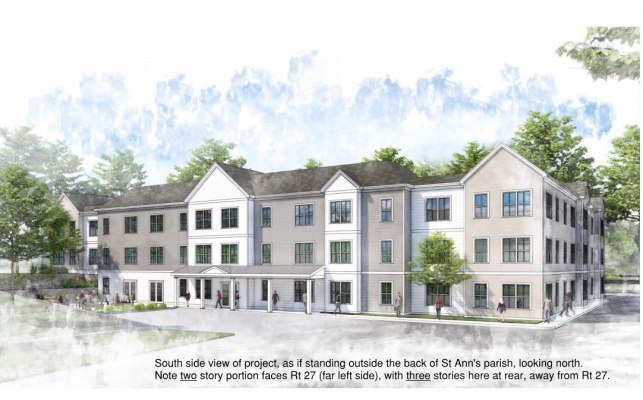
The Saint Ann’s Senior Village project applied for 60 units of affordable housing in May 2023 but was unable to pull a certificate of occupancy by the deadline due to funding issues and has been delayed. The town’s Subsidized Housing Inventory stood at 533 units out of 5,227 year-round housing units, or roughly 10.2% according to a Regional Housing Services Office Inventory. The loss of St. Ann’s projected subsidized units from the SHI drops the number of units to 473 and a 9.05% threshold.
Wayland’s “safe harbor” timeline position above the state’s 10% affordable housing threshold no longer exists. Subsidized units must meet state eligibility criteria and remain under qualifying restrictions to count toward the SHI.
Under Massachusetts Chapter 40B comprehensive permit applications, communities under 10% allow developers to seek zoning relief from local bylaws if a portion of units, usually 25%, are deed restricted as affordable. Zoning boards have more limited grounds to deny such projects, and decisions can be appealed to the state Housing Appeals Committee.
Wayland’s recent position follows the expiration of a two-year, state-approved June 2022 Housing Production Plan safe harbor time period. The town had previously received certification from the Massachusetts Department of Housing and Community Development for its Housing Production Plan, which provided temporary protection after meeting a state housing production benchmark goal — that a 1.0% housing growth increase was achieved even if still under the statutory 10% threshold. That protection expired June 13, 2025.
Since then, the town’s protection from certain Chapter 40B appeals has relied solely on maintaining or moving above the statutory 10% Subsidized Housing Inventory threshold. That threshold had been met as a result of criteria that added the 218 rental units of Alta Oxbow to SHI, although only 55 affordable units were created that were not market rate.
Unlike HPP protections, which last one or two years depending on housing production levels, the 10% threshold carries no fixed expiration date and remains in effect only as long as the certified inventory stays above that level. If that percentage falls below 10%, the protection can be lost immediately.
Using an analysis of the supply and demand of affordable housing and potential barriers to further housing development, the HPP sets a series of qualitative and quantitative affordable housing goals, including a yearly affordable housing production goal. That DHCD approved plan recommended that the Town produce an average of 26 affordable units per year and a set of specific strategies to achieve that goal.
The Wayland Housing Partnership Committee has sought $60,000 for an updated HPP under the Community Preservation Act in the upcoming annual town meeting, article 19 (f).
The town’s current SHI position reflects the accumulation of multiple developments over time, including larger multifamily projects like Alta Oxbow and smaller scattered-site units. While some developments include long-term or perpetual affordability restrictions, others may be subject to compliance or certification updates.
The SHI number of qualifying subsidized units can change if affordability restrictions expire, units are removed from eligibility, or state certification counts change. Also, the number of units necessary to reach the statutory 10% threshold will increase if the overall year round housing count in town increases with moderate residential growth. Both of those factors could occur at the same time increasing the challenge of reaching the 10% threshold.
At some point that residential growth will occur. In 2021, the State Legislature enacted MBTA Communities Act requiring all 177 cities and towns in the MBTA service area to adopt “as-of-right zoning” that allows multi-family housing. Wayland is an “MBTA Adjacent Community” due to the train stations in Lincoln, Natick, Concord, Framingham, and Weston. The new town zoning districts must allow a total of 750 units of “as-of-right” multi-family development of 15 units per acre (on average) in one or more locations totaling 50 acres.