By Veronica Hernandez
Christina Alfaro remembers watching her mom juggling being a single mother of two and owning her own independent real estate business in Wayland and cell phone stores in Waltham. Whether it was commuting between stores, getting inventory, paying bills, or reading about money management, Alfaro’s mother made finances an open conversation, not to be shied away from.
That transparency left an imprint on Alfaro, who grew up not only hearing about how money worked but seeing it in real time.
Two years ago, after graduating from Hawaii Pacific University, Alfaro returned to Wayland. She began searching for nonprofit work in Massachusetts. One simple Google search led her to Women’s Money Matters, an organization dedicated to helping women and girls improve their financial health. Alfaro resonated with its mission.
“I was like, ‘Oh, women’s money does matter’,” she said.
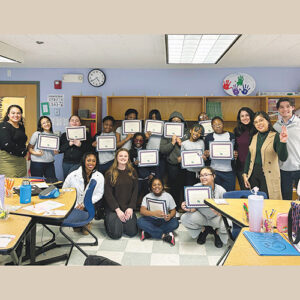
Alfaro has now been part of WMM since January 2025. Currently, she serves as a program lead and tech lead. Her responsibilities include facilitating financial workshops where participants are guided through topics such as credit, expenses, budgeting and investing. She also manages workshop logistics, helps pair participants with volunteer coaches and ensures both in-person and online sessions run smoothly.
While Alfaro was financially active and conscious of money at an early age because of her mother’s transparency, she said not many women have someone to speak to about financial matters. WMM is a step toward solving this issue.
The organization has three different programs for girls as young as eight years old to women of retirement age. It creates a space where financial conversations that are often considered taboo are able to happen openly. Alfaro said the organization and its programs exist to prevent women from learning how to manage their finances “the hard way.” Proof of its success lies in participants returning for more workshops and “raving” about what they learn after each session.
“This program works,” Alfaro said. “It’s valid enough to share locally because its mission and its purpose speaks for itself.”
WMM Associate Director of Programs and Advocacy Carla Poulos said the organization’s mission focuses on empowerment rather than intrusion. “We don’t tell women what to do,” she said. “We empower them to make the right decisions for themselves.”
Workshops run in six-, eight- or 12-week cohorts, where participants attend weekly sessions and are paired with a volunteer coach for individualized support. These coaches meet with participants both during and outside of sessions to help apply financial concepts to real-life situations. According to Poulos, the impact is simultaneously measurable and personal.
“On average, it’s a 254% increase in savings, 26% increase in monthly income, 40 or more point average credit score increase,” Poulos said. “Women have each other’s back, so to speak. It’s a community and everyone can share experiences together.”
Poulos said many WMM participants grew up experiencing financial difficulties through their parents. For Poulos, the sense of community and financial wellness WMM brings to its participants is important for smaller towns such as Wayland, as the organization’s impacts can have a “ripple effect.”
“If women living on low incomes in Wayland are able to take our workshops, to feel confident, to feel secure in their choices, then that ripples down to the next generation,” Poulos said.
Alfaro said the current financial system was not made for women, pointing to the pink tax — a term used to describe additional costs for items marketed toward women — the gender wage gap and a loss of salary earnings after motherhood. Other community members listed similar financial issues women face.
Beyond systemic barriers, Poulos said another issue is a lack of financial education within the school system. Despite her role in WMM, Poulos herself had no financial instruction growing up and said she would have appreciated a similar organization to help her along.
“If you’re in school and you’re not learning about a checking account or credit or how to plan and budget money, why would you necessarily know how to just suddenly wake up one day and know how to do it as an adult?” Poulos said.
For Alfaro, WMM is a way to confront these issues by supporting women with financial knowledge and advice. The organization not only helps personal financial growth, but also encourages participants to share what they’ve learned with others.
“We learn and we share,” Alfaro said. “You don’t know who’s listening that needed to hear that.”
This story is part of a partnership between the Wayland Post and the Boston University Department of Journalism.