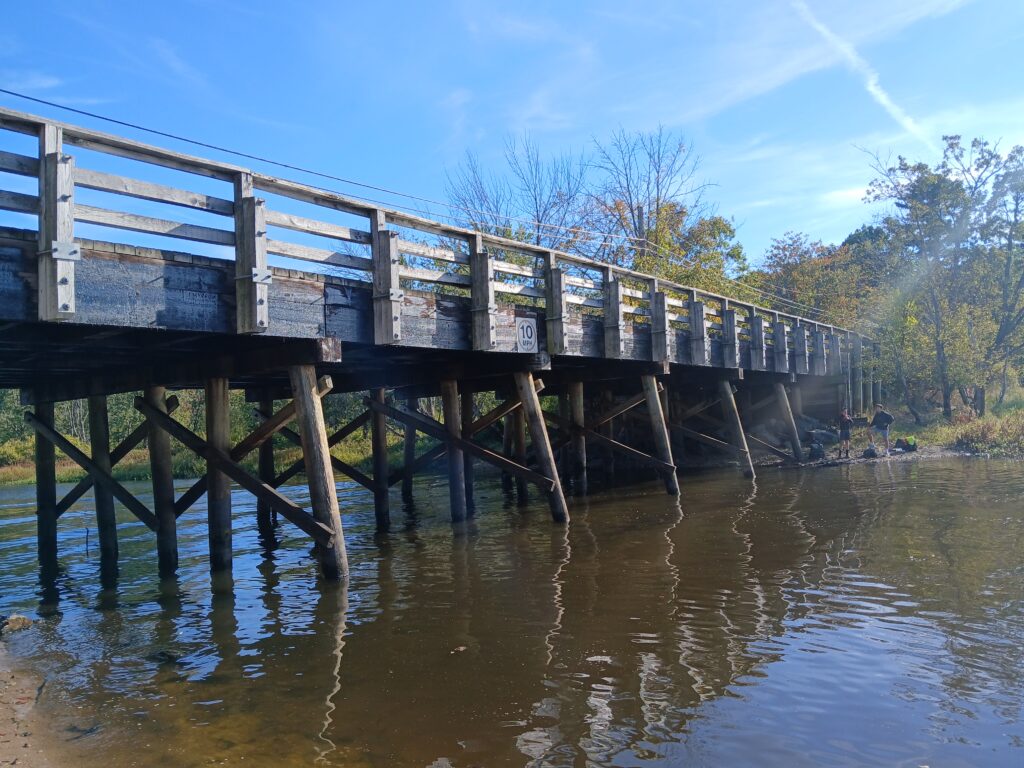
The Conservation Commission voted unanimously on May 27 to reject chromated copper arsenate as a wood preservative for the planned rehabilitation of Sherman Bridge and continued its review of the project while seeking additional information on other preservation treatment methods.
The bridge rehabilitation project is being undertaken jointly by the Wayland and Sudbury departments of public works. Between Sherman Bridge Road in Wayland and Lincoln Road in Sudbury, the bridge spans the Sudbury River, which lies within the federally protected Sudbury, Assabet, and Concord Wild and Scenic River corridor and under the jurisdiction of the U.S. Fish and Wildlife Service’s Great Meadows National Wildlife Refuge.
The federal protections place limits on stormwater improvements and herbicide application. During the hearing, environmental consultant Peter Engel of TEC Inc., stated that discharging stormwater beyond the road right-of-way would require work on federal refuge property, so no project work was proposed outside the municipal right-of-way.
The project would raise the bridge deck approximately three inches. Engel said the increase would result in about 555 cubic feet of fill within the floodplain across both communities, including approximately 285 cubic feet in Wayland. Modeling conducted for the project concluded that the change would not produce a measurable increase in 100-year flood elevations and met federal “no-rise” standards.
TEC Inc. engineer Michael Riccardi told the commission that the existing bridge deck is experiencing significant deterioration, including rotting decking boards, failing fasteners, and structural connections requiring repair. The proposal includes replacing the current decking with glued laminated timber panels (glulam) and an all-wood wearing surface, repairing deteriorated braces and fasteners, and installing crash-compliant timber railings.
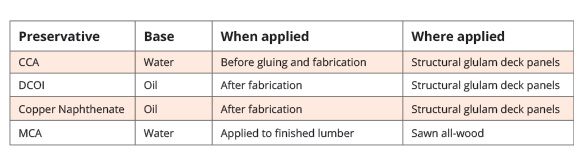
A significant portion of the discussion focused on wood preservatives proposed for the glulam decking and the rough-sawn all-wood lumber components. Timing had become an issue because the project team was trying to keep the bridge rehabilitation on a schedule that would allow construction to occur in 2026 to use Massachusetts Department of Transportation assistance, and the choice of preservative affected when the glulam deck panels could be manufactured.
Riccardi outlined three alternatives: chromated copper arsenate (CCA), dichloro-octyl-isothiazolinone (DCOI), and copper naphthenate (CuNap). The key decision facing the commission will be between DCOI and copper naphthenate for the structural glulam deck, since CCA has effectively been rejected by Wayland and Sudbury. MCA is intended only for the pedestrian-contact wood components.
Riccardi said CCA offered the longest documented service life but contains arsenic and chromium, while DCOI and copper naphthenate are newer alternatives with fewer environmental concerns. Hansen expressed concerns about potential leaching-related toxicity, as the bridge lies within a sensitive river corridor and a priority habitat area. Commissioner Cliff Lewis questioned the durability, leaching characteristics, and long-term performance of the various treatments.
Wayland’s ConCom voted unanimously to prohibit the use of chromated copper arsenate (CCA) on the project. ConCom requested additional information regarding the remaining treatment options and continued the hearing to June 17. Sudbury’s ConCom and ZBA, on June 1, discussed the preservative options and indicated concerns about CCA, but continued their hearings without taking a formal vote, seeking additional information before making a decision.
The joint project is also under review by the Sudbury Conservation Commission and the Sudbury Zoning Board of Appeals. Sudbury officials continued their hearings and said the goal is to complete construction before the end of 2026 while preserving the bridge’s historic character.
On another matter, Wayland ConCom unanimously denied a request for a certificate of compliance for 26 Rice Road, formerly known as 3 Thompson Road. The commission will require the property owner, Adam Stack, to file a new notice of intent reflecting the project as built.
The ConCom members concluded that the surveyed vernal pool and associated amphibian habitat had been significantly degraded, if not effectively destroyed, as a result of the project being built substantially differently from what was approved in 2018. Despite initial assessments confirming its certifiability, the pool was found non-certifiable after work was done.
Wetland scientist Doug Dillon of GZA Consulting and engineer Vito Colonna of Cornerstone Engineering presented as-built plans showing that the house was built in a different location than originally approved, additional structures had been added, parts of the stormwater system were not installed, and a driveway expansion created about 520 square feet of additional pavement.
Hansen, the Conservation administrator, said conditions of the original permitting process, intended to preserve amphibian migration routes, protect habitat, and require certification and monitoring of vernal pool activity, had not been fulfilled. Commissioner Barbara Howell, who participated in the original review, said the driveway location and habitat protections were specifically designed to protect the vernal pool and associated wildlife movement.
The commission also authorized another season of herbicide treatment and hand-pulling efforts to combat invasive water chestnut growth in Heard Pond.