This is the second of a two-part series on WayCAM. The first, “WayCAM: A Key Conduit to News and Community,” appeared in the June 26 issue — read it on waylandpost.org.
Despite record online viewership, WayCAM faces declining revenue as shrinking cable subscriptions erode the funding model that has supported the community television station for decades.
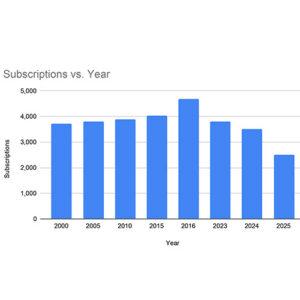
Executive Director Jim Mullane said WayCAM online programs tracked 81,000 views last year, compared with 12,000 in 2017. This coincides with an increase of 300 programs produced in 2025, he said. However, he said cable subscriptions in Wayland declined about 50%, falling from 4,676 in 2016 to about 2,500 today.
Until the last few years, WayCAM generated nearly 100% of its operating revenue from contractual license fees paid by providers operating in Wayland. The Cable Communications Policy Act of 1984 mandated that cable companies pay towns up to 5% of the gross annual revenues from subscribers living in the town because the cable companies are profiting from public infrastructure such as digging up sidewalks and wiring across publicly owned utility poles.
Total organizational revenue peaked from 2010 to 2016 at roughly $360,000 to $400,000 annually, following the introduction of Verizon FiOS to Wayland, adding a revenue stream alongside Comcast. However, current revenue from cable companies is estimated at $60,000 to $100,000.
To offset the deficit and staffing cuts, the station introduced new paid membership tiers. A household has two different streaming options for $36 and $47 a quarter. There are also business and non-profit memberships, and a discounted Wayland High School student membership.
Mullane said WayCAM could no longer afford to give free streaming access for something that costs them $15,000 a year. Although streaming is no longer available for free, Mullane said households that have cable can view some of the town meetings scheduled on the public television station. For example, he said that Select Board meetings are shown twice a day.
WayCAM’s finances, Mullane said, were also impacted after a 2019 Federal Communications Commission ruling allowed cable companies to count certain in-kind services toward their required local franchise fee contributions. The new rules mandated that most non-cash, “in-kind” contributions — including costs for public, educational, and governmental access — be assigned a fair market value and counted against the statutory 5% franchise fee limit. The original 1984 FCC law left significant ambiguity regarding how non-monetary requirements like free cable for municipal buildings or studio equipment should be tallied. Therefore, before 2019 the towns could exclude the in-kind services.
Becoming an independent 501(c)(3) nonprofit organization in 2021 also impacted WayCAM’s funding. Before then, the operational funds and capital grants collected from the cable company were held and managed by the town of Wayland, according to Mullane. Under the new structure, the cable companies still pay fees directly to the town, but the town is contractually obligated to immediately pass 100% of those operational grants through to WayCAM rather than managing them. Although the receipts are essentially the same, WayCAM is now entirely responsible for its own financial deficits rather than the town of Wayland.
However, the town paid a $30,000 streaming fee to WayCAM in 2023 and 2024 when it negotiated a partnership with the Select Board. This fee allowed residents, school employees, and volunteers to access municipal media services, but it was discontinued last year when town leadership determined there was no room in the town budget to continue the partnership.
Mullane emphasized that although they no longer receive funds from the town, WayCAM is still responsible for maintaining and replacing broadcasting equipment at town hall, the high school, Council on Aging, and the library. The out-of-pocket technical costs to lease and maintain the servers required to stream town events and host on-demand video playback online cost $13,000, Mullane said. Hardware and major overhauls often rely on external capital infusions from other sources. Large-scale upgrades like the school sports broadcasting system, including robotic cameras, were financed via community grants from the Wayland High School PTO rather than general town maintenance budgets.
Wider problem
Problems in funding local television are not unique to Wayland. Other towns and cities are searching for ways to support their local broadcasting. Winchester created an enterprise fund, treating local media like a municipal water or utility department, to pool reserves. Westborough voted at its Town Meeting to allocate property tax levy to cover budget gaps. Lexington supplemented its respective loss of funds through a new line item in the town’s budget, including $100,000 in FY2025 and $200,000 in FY26.
State and federal legislators are also seeking alternative ways to fund local television. Federal lawmakers introduced the Protecting Community Television Act, which specifies that “in-kind” obligations cannot be used by cable providers to chip away at monetary franchise fees.
Advocacy network Mass Access is working with Massachusetts state representatives to revamp outdated funding formulas. Rather than increasing the fee percentage, House Bill H.106 seeks to change who pays the assessment by expanding the definitions to capture modern streaming providers. It establishes a state-level regulatory framework to capture revenue from digital entertainment ecosystems that rely on public infrastructure. The fee strictly applies only to streaming operators earning over $250,000 annually in state revenue. Unlike traditional franchise fees that go entirely to local municipalities, the money collected under this framework is managed by a newly created Streaming Entertainment Fund and split three ways:
40% allocated directly to community media centers (public, educational, and governmental stations) to fund local broadcasting, community studios, and equipment.
40% distributed to municipalities based on population to cover local infrastructure costs, hybrid town meetings, and school technology.
20% funneled into the Commonwealth’s General Fund to cover oversight and administrative expenses.
Bill H.106 was reported favorably by the Committee on Advanced Information Technology, the Internet and Cybersecurity, and was referred to the House Ways and Means Committee. As of June, the bill remains pending in the Ways and Means Committee, awaiting further fiscal review.
Mullane said he hopes new memberships, community support, and legislative changes will help stabilize funding while the station continues producing local programming.