By Karen Blumenfeld
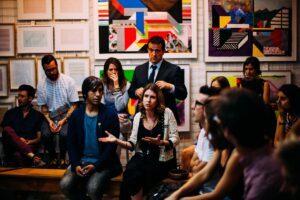
On June 30, 40 community members gathered at the Wayland Free Public Library to wrestle with history.
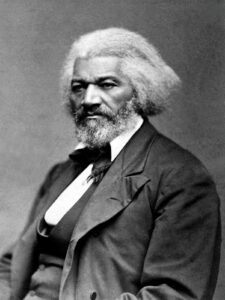
The occasion was a communal reading of Frederick Douglass’s 1852 address, “What to the Slave Is the Fourth of July?” Douglass was a formerly enslaved man who became one of the era’s most powerful abolitionist orators. In his speech, he challenged America to live up to its ideals at a time when the nation was congratulating itself on liberties it had not yet extended to people of color or women. Nearly 175 years later, his formidable remarks were passed, voice to voice, among people who had come to the Wayland Free Public Library to experience how his words echo today.
Dr. Eden-Reneé Hayes, Wayland resident and CEO of Pluralism Solutions, guided the group through the abridged text and then opened the floor. What followed was not comfortable, and it wasn’t meant to be. People spoke candidly about what parts of the speech resonated with them, and addressed a question that has outlived every generation of Americans: why has racism endured in this country since its founding, and what responsibility does each generation have to close the gap between America’s ideals and its realities?
That Wayland community members chose, on the eve of the country’s 250th birthday, to hold up the same mirror Frederick Douglass held up to his audience, speaks to a civic sensibility worth acknowledging. “It was a pleasure to see so many people gathered together to hear such stirring and thought-provoking words,” said attendee Jane Sciacca. “Abolitionists like Frederick Douglass and Wayland’s Lydia Maria Child were not so well received in their time. I wish they could have had as receptive an audience as there was at the library.”
For many, the evening was also a reminder that reading Douglass’s words is not an end in itself, but a starting point.
“My favorite Frederick Douglass quote has always been ‘Power concedes nothing without a demand’,” said attendee Sabine von Mering. “The collective reading was a great reminder that living in a democracy is not just a privilege, but an awesome responsibility.”
This program was organized by the Wayland Free Public Library, Wayland Human Rights, Diversity, Equity & Inclusion Committee (HRDEIC), the Wayland Museum & Historical Society, and the Wayland Rev250 Committee. It was made possible by a grant from Mass Humanities, which provided funding through the Massachusetts Cultural Council (MCC). Mass Humanities is a state-based affiliate of the National Endowment for the Humanities.
Blumenfeld is the chair of the Human Rights, Diversity, Equity and Inclusion Commission.