Could Rose Cleveland and Evangeline Simpson Whipple have known their story would remain an intriguing part of Wayland’s history more than a century later? Could they have imagined that today we would celebrate them during Pride Month?
Their story, told in the book “Precious and Adored: The Love Letters of Rose Cleveland and Evangeline Simpson Whipple,” edited by Tilly Laskey and Lizzie Ehrenhalt, features wealth, fame, love, and longing. But Laskey, who recently gave a talk on her book at the Wayland Museum & Historical Society, wants readers to understand that it is also a story about creating a meaningful life.
Evangeline Marrs Simpson may be known to some Waylanders because of her association with The Mansion Inn, a swanky restaurant and ballroom that graced the banks of Dudley Pond from the 1920s to the 1950s. Before it was a popular destination for a fancy night out, it had been her home, an opulent mansion built for her in 1882 by her new husband, Michael Simpson. A well-known textile magnate, owner of the Saxonville Mills and Roxbury Carpets, Simpson was 44 years older than Evangeline.
Born in Canton in 1853, Evangeline was a young child when her family moved to Wayland. Her parents, Dana and Jane Marrs, bought property on Dudley Pond, in the area now bordered by Old Connecticut Path and West Plain Street.
When the 29-year-old Evangeline married the 73-year-old Simpson, gossipy newspaper articles suggested she was after his money. But reports suggest theirs was a happy marriage. Sadly, it was brief — Simpson died just two years after they wed, leaving Evangeline with the mansion and the equivalent of $64 million in today’s dollars.
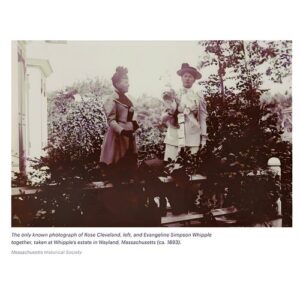
Evangeline traveled in Europe and North Africa for several years with her parents and brother, returning eventually to the U.S. Somewhere in her travels — it’s not entirely clear where — she met Rose Cleveland, sister of President Grover Cleveland.
Rose Cleveland had served as the nation’s first lady during her unmarried brother’s first year in office. A well-educated intellectual, Rose chafed at the domestic duties of First Lady. She authored books on poetry and history, and supported women’s suffrage and Indigenous sovereignty.
Evangeline and Rose formed a strong bond. They shared a desire to help others. And Rose’s letters to Evangeline through the ensuing years reveal a deeply romantic and passionate relationship.
Laskey, who is currently writing a biography of Evangeline, says that in the Victorian era it was not unusual for two women to have a deeply personal or intimate relationship.
“Rose and Evangeline didn’t have to hide their relationship,” she says. “Their families were aware of how close they were, and they were integrated into each other’s families.”
But in the 1920s, the emerging study of psychology began to label queer behavior as “deviant,” says Laskey, and history began to erase stories like Rose and Evangeline’s. With their book, Laskey says she and her co-author hope to “combat the erasure and normalize these relationships. Queer youth have high rates of depression and suicide, and we want them to hear the stories of these ancestors they can look to, and potentially feel not so alone.”
Rose and Evangeline traveled together extensively, and on their travels they met Bishop Henry Whipple and his wife Cornelia, from Minnesota. In 1896, six years after Cornelia died, Evangeline married the bishop and moved to Minnesota. Rose’s letters to her during this period changed in tone, says Laskey.
Evangeline stayed in Minnesota for 14 years, including nine years after the bishop’s death. She devoted herself and her wealth to philanthropy, establishing a school for girls to improve their educational opportunities and advocating for Native American rights.
In 1910, learning that her brother in Italy was gravely ill, she traveled there. Rose went with her. The two women made a life together in Bagni di Lucca, devoting themselves to humanitarian work with the poor and with World War I refugees. They worked extensively with the Red Cross during the war, caring for wounded soldiers, and later for victims of the Spanish flu epidemic in 1918.
After nursing a friend, Rose contracted the flu and died. Evangeline lived another eight years, passing away in England in 1930. Following her instructions, her body was returned to Italy and buried next to Rose, where the two have identical markers. It was only when gifts of property and money were made to the town according to her will that the locals knew she had been wealthy. A major roadway in Bagni di Lucca now carries her name: Via Evangeline Whipple.
“Evangeline could easily be seen as an accessory — as a wife, as the object of Rose’s letters,” says Laskey. And her rich life story could be overshadowed by her love affair with Rose. “But she lived a life of purpose and used her wealth to improve the lives of others. She should stand in her own light.”