By Mary Farley, Elisa Scola, and Gretchen Schuler
A house is one of the most tangible ways to connect to our past. The history embedded in an old dwelling tells the story of the most personal parts of daily life in a different era. The placement of the kitchen, the size of the hearth, the lack of some amenities we now take for granted — all of these signs can help us understand more about how our predecessors spent their hours and days.
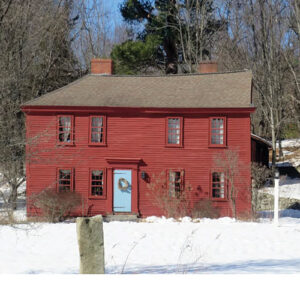
As part of Wayland’s Rev250 celebrations, the Wayland Museum & Historical Society has coordinated “Still Standing: An Historic House Tour” on Sunday, May 3, from 2:00-4:00 p.m., which will allow visitors a rare look inside some of the oldest houses in Wayland. Five houses dating back to 1776 will reveal elements of their long history — and how they have been adapted for modern life.
When established in 1638, the center of the Sudbury settlement, which included both modern-day Sudbury and Wayland, was originally located on Old Sudbury Road near the North Cemetery and is now called Cow Common. The land next to the Sudbury River was shared as pasture, and to the east, settlers were apportioned land for farming. Some of Wayland’s oldest homes can still be found along Old Sudbury Road. The town expanded west and south as bridges were built over the river, and by the mid-1700s. Sudbury was one of the largest west of Boston.
In 1776, Sudbury had two precincts: East Sudbury, which would eventually become Wayland, on the east side of the river, and Sudbury on the west side. It also had one of the largest militias in the area, with about 400 men.
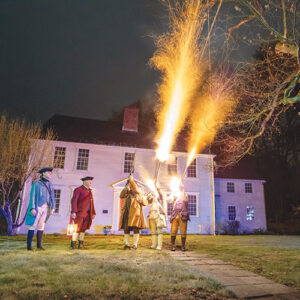
The eastern and western precincts of Sudbury sent at least 302 men on April 19, 1775, to Concord to join other militia in the first major battle of the Revolutionary War. The Sudbury Minutemen recreate the march through Wayland every year on April 19. Fifty-six men who fought in the eight-year-long war are buried in North Cemetery.
We can only imagine the political upheaval that residents were experiencing, the daily tasks of agriculture or commerce that kept them busy, and the taverns and inns where they met in the evenings to discuss the issues of their town and their soon-to-be-born nation.
Wayland has 18 houses that were standing in 1776; five of them will be on the self-guided tour, part of the statewide celebration of the 250th anniversary of American independence.
Tickets can be obtained at waylandstillstanding.eventbrite.com.