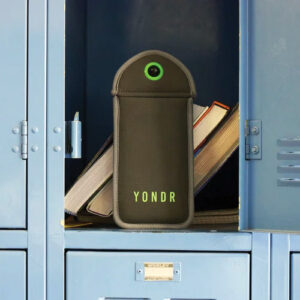
During the 2024-25 school year, there were 126 phone infractions at Wayland Middle School. This year, in the four months of Yondr pouch usage, there have only been 30.
Principal Deborah Romeo credits a big part of the success to spot checks performed during the day by her and Assistant Principal Rowley.
“We are definitely seeing a decrease in phone use and therefore, a decrease in negative reaction,” Romeo said, “Every day Ms. Rowley and I go into classrooms and check. We are seeing less devices being brought to school.”
Romeo, who has experience with cell phone pouches at her last school district in Newton, also believes educating parents and students have contributed to the drastic decrease.
The Yondr Pouch rollout started on Oct. 15after a parent information session held last September which clearly outlined expectations and adherence to the integrity of the program.
Students at WMS pick up the pouches, labeled with their names and home rooms, upon entering the building. They place their cell phones or smart watches inside and carry the locked pouches in their bags. Once that pouch is locked, there is zero opportunity to use the devices during the school day.
WPS is one of many districts in Massachusetts seeking ways to curb phone usage and increase engagement in the classroom. Last fall’s rollout to the Yondr pouches transitioned middle schoolers from the “off and away” policy that required and relied on kids to put their phones or smart watches in their backpacks.
“Now it’s seven hours that [phones and watches] are out of sight, out of mind,” says Lorie, parent of eighth-grader Annie. “I’m OKwith that. I think it is a good thing for her. She doesn’t even have the option of playing a game or using her phone for anything else.”
Lorie and Annie asked to remain anonymous in order to not identify the middle school student.
On the other hand, Annie, who did not even have a cell phone until the beginning of eighth grade,will tell you that she (and her friends) “hates” the Yondr pouches and wishes she could have been trusted to put her phone away. Lorie, however, remembers many conversations with Annie who constantly complained about phones being used in classes, causing multiple distractions and yielding few consequences.
Lorie says most of the mothers and fathers in a parents friend group are in agreement and laud the district’s decision to employ the Yondr pouches. One parent, however, felt that the pouches were inexpensively made, easily broken and thus ineffective. Her son’s pouch broke within the first few weeks of use.
Math teacher Michael Kotin notes that he has seen an increase in class engagement with the implementation of the Yondr pouches.
“I feel like the introduction of the Yondr pouches has led to less distractions in the classroom and in the building generally.” he said. “Students are students — if a lesson isn’t engaging to them, they still can be distracted. At the same time, (now) there isn’t something actively pulling their attention away from the lesson in front of them.”
Mattie Shtutin is one of many sixth graders who has neither a smart watch nor a cell phone. He will receive one as a gift for his Bar mitzvah when he is in eighth grade. Sarah Shtutin describes her son as a “free roaming kid” and trusts him to be where he is supposed to be without having to check in via cellphone.
“He knows to email me if the plan changes,” she said. “I realize that all children have different levels of responsibilities, so we will assess the cell phone age and situation with our daughter as she matures [and reaches Mattie’s age].
I am happy that they implemented this plan because now the kids can put it (their devices) out of their minds.”
Kotin feels other than kids not having a phone or smart watch at all, the pouches are a good alternative.
“The only way to truly have students not use phones at school is for families not to give their childen phones,” Kotin said. “If a child has a phone, the temptation to use it is simply overpowering. Since students do have phones, there needs to be some way to remove them [or, at least, minimize their access to them] while they are at school. If there is a better system, I’m not familiar with it, so we do the best we can with what we’ve got.”
The district will continue to gather data related to Yondr pouches as the academic year continues.