By Steve Garone
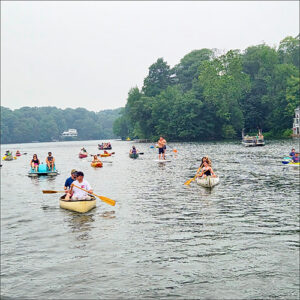
Spring at Dudley Pond offers the promise of recreation and fun on the pond. Come summer, it means work for others.
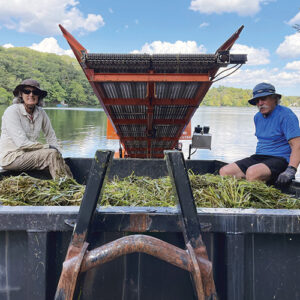
Dudley Pond Association members Allison LeClaire and Jim Ogletree will begin the taxing work of cutting and collecting weeds in Dudley Pond starting in July. The town hired the Wayland residents to assist the Department of Public Works in cleaning the pond. The project will take up to 10 weeks to complete. They harvested over 60 tons of weeds in 2025.
In recent years, Dudley Pond, considered one of the town’s jewels, has faced challenges with the proliferation of weeds. The growth could harm pond health and prevent swimmers, paddle boarders, and boaters from enjoying it.
Ponds are de-weeded to maintain a balanced aquatic ecosystem, preserve water quality, and prevent water bodies from becoming choked out by invasive growth. Overabundant weeds deplete dissolved oxygen and can harm fish, according to the state Department Conservation and Recreation.
Scientists say that as massive amounts of weeds die and decay, they can release hydrogen sulfide gas, creating a strong “rotten egg” smell that ruins pondside relaxation. Stagnant, weed-choked water blocks natural wind action and wave movement, creating the perfect calm environment for mosquitoes to breed.
Weeds ruin recreational activities by physically blocking water access, tangling equipment, creating safety hazards, and ruining the aesthetic and sensory experience of a water body.
The threat of tape grass
Dudley Pond has seen a proliferation of a weed called tape grass. This native, indigenous weed cannot be removed chemically, but it can be given a “haircut.” About five years ago, Wayland purchased a harvester to cut weeds far down below the water line. Maintained by DPW, this harvester has been used on Dudley Pond for around two months.
Eurasian water milfoil, an invasive plant, is another weed that has been a particular nuisance. Experts believe it is brought into Dudley Pond by boats used in other infected ponds. The town of Wayland destroys it with chemical treatments roughly every three years. Clasping leaf, another native weed, is also becoming more dominant in the pond and is carefully monitored. It is a springtime algae bloom potentially linked to the relationship between dissolved oxygen and phosphorus.
Wayland’s Surface Water Quality Committee works closely with the Dudley Pond Association (DPA) and that group’s committee, named “Pain in the Grass.”
Both groups focus on the maintenance of the pond, pond safety, improvement of water quality, and other important factors that affect the health of the pond and its safe usage.
The SWQC also oversees other bodies of water that exist within the town’s borders. They evaluate and maintain water quality and also recommend and implement improvements.
The DPA is an organized watershed group with bylaws specifically for the pond’s maintenance. Since its inception in 1968, the DPA has had a program for the pond’s improvement, which includes weed control, litter control, safety, abuse and nuisances, water quality improvement, and community-building events. Their membership and monthly meetings are open to everyone.
In addition to de-weeding the pond, LeClaire, an expert on pond health and weed management, is a frequent presenter at DPA semiannual meetings. She updates watershed residents on the state of the pond and on keeping the pond healthy. She sometimes refers to herself as the “underwater weeder” based on her days as a milfoil diver hand-pulling weeds. She and others involved with the SWQC and DPA are educating residents about herbicides and on how to reduce phosphorus and nitrogen loads to slow down weed growth, including keeping leaves and other waste out of the pond.
Despite the challenges, the SWQC, the DPA, and the DPW have diligently maintained the health and safety of Dudley Pond.