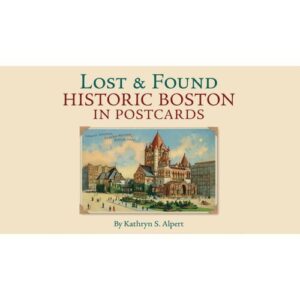
Kathy Alpert was a little girl when a rainy summer afternoon led her away from the lake and into the barn at her grandparents’ New Hampshire farmhouse. Tucked inside, she stumbled upon a basket of vintage postcards — vivid images of faraway places, strange faces, and long-forgotten scenes. She was hooked.
Decades later, that childhood discovery has blossomed into something far bigger. Alpert, a Wayland native, has just published “Lost & Found: Historic Boston in Postcards,” a full-color, 206-page book featuring more than 200 carefully selected vintage postcards that together paint a rich portrait of Boston as it looked 100-150 years ago. Color, Alpert notes, makes all the difference — most postcard books aren’t printed in color, and these images demand to be seen as they were meant to look.
“I just wanted to find the best ones and compile them into a book, so people could really see a picture of Boston the way it looked back then,” she said during a recent interview.
Alpert didn’t have to start from scratch. By the time she began working on the book, she had already accumulated roughly 1,200 Boston postcards — a collection assembled over a lifetime of haunting junk shops, antique fairs, and postcard shows. The challenge wasn’t finding cards. It was choosing.
Working with her brother-in-law Ron Rick, a book designer based in San Rafael, Calif., along with her sister Dr. Cindy (Alpert) Grande of Olympia, Wash., and her mother Sylvia Green of Boston — both formerly of Wayland — Alpert spent months narrowing hundreds of candidates down to the final selection. The process meant constantly weighing beauty against historical value.
Some cards were harder to track down than others. Alpert spent considerable time searching for postcards depicting the events held at the Mechanics Building — a massive, now-demolished exhibition hall that stood near where the Prudential Center is today. The building hosted everything from political rallies and dog shows to electrical exhibitions, and the event postcards, which were small-scale versions of promotional posters, are notoriously difficult to find.
“Postcards are really the way they made art accessible to everyone,” she said. “They’re not as expensive as posters.”
Flipping through “Lost & Found” is, at times, a melancholy experience. Page after page reveals buildings, neighborhoods, and entire city blocks that no longer exist — swept away during the urban renewal projects of the 1960s, or lost even earlier to fire, development, and shifting tastes.
Among the most striking revelations was the Custom House, one of Boston’s most recognizable landmarks, which once had a dome instead of its famous tower. Alpert only discovered this herself by finding the right postcard.
“I grew up here, and I never realized,” she said, laughing.
Then there’s the West End — a dense, vibrant immigrant neighborhood bulldozed in the 1960s. It was replaced by the Charles River Park development and the bleak expanse of Government Center, along with glass towers and parking garages. Whole sections of Washington Street, Scollay Square, and the theater district appear in the book in their full bustling glory.
“I think they’ve already realized that urban renewal was a disaster,” Alpert said. “Thousands and thousands of people [were] driven from their homes.”
Her hope is that the book serves as more than a nostalgia trip. “I want people to appreciate the beauty and history of this city, and have it be instructive, so that they don’t tear more buildings down.”
Alpert’s passion for postcards has never been a solitary pursuit. In 2023, she co-founded the New England Postcard Club alongside Steve Kruskall, a dealer and collector from Dover, reviving a postcard community in the region that had quietly collapsed roughly 14 years earlier. The club holds its meetings and shows at the Spellman Museum of Stamps and Postal History in Weston — a place Alpert describes as “a little gem” that she credits as essential to the book’s existence.
“None of this would have been possible without the Spellman Museum,” she said. “They have been so important to us.”
Each meeting includes a speaker and an auction, followed by a mini-show open to the public. The club holds one larger annual show each March, plus three additional meetings throughout the year.
It was through Spellman that Alpert was invited to launch the book at World Expo Boston 2026, a massive international philatelic convention held at the Boston Convention and Exhibition Center in Seaport over Memorial Day weekend. The event comes to the United States only once every decade — and this year’s edition landed on the eve of the nation’s 250th birthday.
“It’s thrilling,” Alpert said of the timing. “I feel like it’s a positive message at a time when a lot of people are feeling a little uneasy. It’s a hopeful, positive book.”
In an age of artificial intelligence and digital fabrication, Alpert sees vintage postcards as something increasingly rare: an object that cannot lie.
“When you look at something like this, it’s got a postmark on it,” she said, holding up an original card from 1908. “You know it’s really from that year. There’s no way to fake it.”
She worries that postcards — like so much paper ephemera — are too often discarded during what she calls “the three D’s: downsizing, divorce, and death.” Her goal is to rescue unwanted collections before they end up in dumpsters and return them to dealers, institutions, or the public.
For those curious enough to explore the world of vintage postcards themselves, Alpert has a simple suggestion: come to a show. The New England Postcard Club’s next meeting is Sept. 26, at the Spellman Museum of Stamps and Postal History.
“Lost & Found: Historic Boston in Postcards” is available at postmarkpress.com.