Wayland’s Community Preservation Fund closed fiscal year 2025 with $3.61 million, according to the latest state reporting, including just over $1.1 million in uncommitted funds and the rest largely restricted to statutory reserves or long-term obligations.
The figures come from the Massachusetts Department of Revenue’s CP-2 report, the state’s official year-end accounting of Community Preservation Act finances. The data, current as of April 2026, reflect balances as of June 30, 2025, the end of the last completed fiscal year.
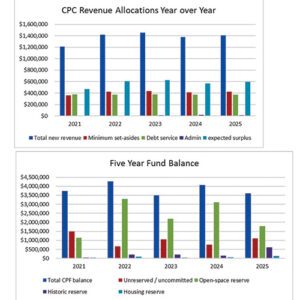
The total Community Preservation Fund balance stood at $3,613,131. Of that amount, $1.10 million was classified as unreserved or uncommitted, representing the portion most readily available for future appropriations approved at Town Meeting.
The remainder of the fund balance is largely restricted to the three categories set by statutory requirement that at least 10% of annual CPA revenue be allocated to each category. Open space accounts for the largest share, with $1.78 milliom held in reserve. Historical resources total $604,820, and community housing accounts for $124,499. No funds were listed as committed but unspent in those specific categories at the close of the fiscal year.
The town’s CPA finances are shaped heavily by debt obligations tied to the Mainstone Farm conservation restriction, financed through a CPA-backed bond. As of June 30, 2025, the town carried $5.78 million in outstanding principal on that bond, with total remaining debt service, including interest, projected at $8.21 million.
That obligation continues to draw annual payments from CPA revenues. In the current budget cycle, the town has allocated $374,032 for CPA debt service, alongside $20,000 for administration and $145,862 for each of the three required reserve categories.
The town retains a small but steady stream of discretionary funding each year. For FY 2025 data, total CPA revenue was $1.41 million After subtracting the required 30% in category set-asides, debt service, and administrative costs, the remaining annual surplus amounted to $597,390.
A similar pattern appears in the current planning cycle. Using figures from the January 2026 town warrant, the total CPA revenue is estimated to be approximately $1.46 million Once minimum set-asides, debt service, and administrative expenses are deducted, roughly $627,000 remains available for new projects before any additional appropriations are made.
That annual surplus has remained relatively stable over time, even as the total fund balance has fluctuated more significantly with the timing of major expenditures. Over the past five fiscal years, Wayland’s Community Preservation Fund has moved between a high of $4.27 million in 2022 and a low of $3.50 million in 2023, before ending fiscal year 2025 at $3.61 million.
During the same period, the annual surplus after mandatory allocations has ranged from approximately $469,000 to $626,000, indicating a consistent level of new funding capacity year over year.
The fiscal year 2025 decline in total balance is attributed in part to open space acquisitions, according to the town’s audited financial report. Those expenditures draw down accumulated reserves even as new revenue continues to flow into the fund.
The composition of the fund highlights the constraints on spending flexibility. Open space reserves alone account for roughly 49% of the total balance, while the uncommitted portion represents about 30%. Historic resources make up approximately 17 percent, and community housing about 3%.
These proportions underscore an important distinction in CPA finance: the difference between the total balance and the funds truly available for new spending. Although the fund’s headline figure exceeds $3.6 million, a substantial portion is either restricted by law or already committed through long-term plans and debt.
The uncommitted balance of $1.1 million, combined with the annual surplus of roughly $600,000 together defines the town’s near-term capacity to fund new Community Preservation Act projects without drawing down reserves or increasing debt. For a listing of all the projects funded by CPC revenues see Wayland Post website.
As Town Meeting considers future CPA appropriations, those statutory constraints will remain central to discussions about project prioritization, reserve management, and long-term financial planning for new initiatives in any given year.