dave.watkins@waylandpost.org
A documentary that screened at Regis College on March 23 is raising a question that resonates beyond campus and into communities like Wayland: where do young people today find real, in-person community?
The film, “YRUU,” examines the Young Religious Unitarian Universalists program, a national youth movement that operated from 1983 to 2008 through Unitarian Universalist congregations. While the screening took place in Weston, the themes have local relevance in Wayland, where First Parish in Wayland continues to serve as a hub for religious education and youth programming.
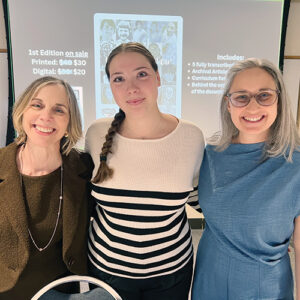
Introduced by Naomi Kooker, a Regis associate professor and producer on the film, the documentary explores how YRUU helped young people navigate identity, belonging and purpose. Kooker said the project grew out of former participants reflecting on how the program shaped their lives.
Unlike many traditional youth groups, YRUU was largely youth-led. Teenagers organized conferences, elected leaders, created programming and set community norms, with adults serving in advisory roles. Participants said that structure gave them a level of responsibility and ownership rarely found elsewhere.
“The youth who participated in the Young Religious Unitarian Universalists program (from 1983-2008) were part of intentional gatherings that the youth led,” said Lindsay Caddle LaPointe, the film’s director. “They often showed up because it was the only place where they felt safe to be themselves and knew it was okay to evolve as a human being. Older youth would lead by example and then teach the younger ones how to build a community that fostered spiritual development and leadership skills.”
Several described learning leadership through experience. If youth failed to organize an event, it did not happen. Others said the program provided a space where they could be fully themselves, particularly around issues of sexuality, mental health and identity.
The film also presents a more complicated picture. Former participants acknowledged problems, including exclusion, racial imbalance and inconsistent adult oversight. Some said the same freedom that made the program powerful also created risks.
YRUU formally ended in 2008 after losing denominational funding. In the film, former Unitarian Universalist Association President William Sinkford describes the handling of that transition as a mistake. Participants described the closure as a loss not only of a program but of a broader youth culture that has not been fully replaced.
At a panel discussion following the screening, speakers connected those themes to current conditions.
Joseph Draper, dean of the School of Arts and Sciences at Regis, said the program stood out for encouraging both community-building and critical thinking. He said it allowed young people to examine broader issues such as inequality and social systems, rather than simply participate in a single congregation.
“When the youth gathered, they established a covenant for the time spent,” LaPointe said. “For example, there is no exclusive behavior. If someone is alone, another youth would commonly check in on them. Although phone use was not part of the program’s initial timeframe, I myself have witnessed youth in the Unitarian Universalist faith today asking their peers to put their phones away while they are together.”
Mary Lou Bozza, an assistant dean involved in campus ministry, said institutions often underestimate the importance of youth voice. She said organizations that fail to engage young people risk losing not just participation but insight into changing social dynamics.
Those observations align with trends visible in Wayland. Youth sports and school activities remain strong, but participation in civic and religious institutions has become less consistent, reflecting broader national patterns.Congregations such as First Parish continue to offer youth programming, but they operate in a different environment than the one in which YRUU developed. Panelists pointed in particular to the role of technology. Today’s teenagers are more connected digitally but often less connected in person, with social media shaping how they present themselves and interact.
Kooker said she has seen early signs of a countertrend, with some young people seeking out technology-free spaces and more direct personal interaction.
The discussion suggested that the core issue is not replicating a past program but understanding what made it effective. Key elements included youth leadership, peer connection, adult support without over-control and the ability to engage with real-world issues.
In Wayland, those elements appear in more limited forms, such as student involvement in school and town activities. The YRUU model points to a deeper level of engagement, where young people are not just participants but decision-makers.
Another theme was intergenerational impact. Speakers said YRUU functioned as part of a broader community, and its loss affected entire congregations, not just youth. For local institutions, that raises a broader question about sustainability. When younger participants disengage, the long-term effects extend beyond a single program.
The film ultimately leaves an open question: what would it take to build a meaningful youth community today. What the discussion made clear is that the need has not diminished. If anything, participants said, it has become more urgent.
“The film’s overall message is that when you empower youth at a young age they can thrive as adults,” LaPointe added. “Many participants say they haven’t seen a better-run government structure (that was youth-led) since their days in YRUU.”