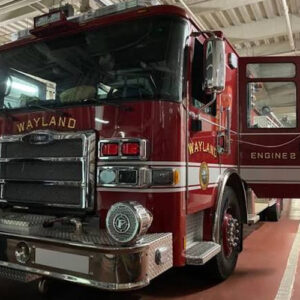
Richard MacKinnon Jr., president of the Professional Fire Fighters of Massachusetts, is circulating a letter in Wayland alleging that Town Manager Michael McCall is responsible for the denial of work-related injury claims.
The letter said that “over the last several years, firefighters witnessed a pattern of line-of-duty claims being denied despite substantial evidence and documentation supporting those claims” and mentions a specific case about a pregnant firefighter. It also references a recent staff study which “found that Wayland firefighters are operating below recommended staffing levels approximately 76% of the time.”
His letter said that early in McCall’s tenure, the town required firefighters to undergo independent medical exams regarding injury claims. The Union challenged the decision and prevailed in arbitration, it stated. The letter appealed to residents to “show the same commitment to its firefighters that firefighters show to residents.”
There was no mention of ongoing contract negotiations in the letter. However, the town has not settled the contract running from July 1, 2026 to June 30, 2029 with the Association of Firefighters IAFF Local 1978. Pending a new collective bargaining agreement, the firefighters continue to work under the terms and extensions of their previous labor agreement. The firefighters’ contract that ran from July 1, 2023 to June 30, 2026, was not settled until February 15, 2026.
Responding to a request for comment, McCall said, “The town of Wayland supports and appreciates the noble work and sacrifices of our professional firefighters. We offer some of the most competitive starting salaries in the region for firefighters, and we work to ensure that the men and women of the department have modern and efficient equipment and apparatus and advanced training. The Town of Wayland has a long history of cordial and professional negotiations with all of our employee unions, and we actively negotiate in good faith at all times. The Town will continue to negotiate in the best interests of both our residents, taxpayers, and our employees. While we are actively engaged in this process, the Town will not negotiate in the media nor comment on personnel, contract negotiations, or pending legal matters.”
Under Massachusetts General Laws Chapter 41, Section 111F, a firefighter injured in the line of duty receives injured-on-duty leave without loss of pay. This benefit continues until they either retire or a “physician designated by the appointing authority” determines that the incapacity no longer exists. However, it is standard legal and administrative practice for towns and insurance carriers to require a claimant to undergo an independent medical exam when they pursue a claim for payment for a long-term or permanent disability. In Massachusetts, this custom is backed by statutory law and local collective bargaining agreements.
Staffing
Like its neighbors and most Massachusetts towns, Wayland is coping with staffing shortages due to fiscal constraints related to Proposition 2½. Similar to many fire departments surveyed by local unions, Wayland did not meet the National Fire Protection Association) standard of four on-duty firefighters per engine. Wayland employs 26 uniformed firefighters.
Wayland and a vast majority of suburban and small-town fire departments across the United States rely on an older staffing structure that has not adapted to a 25-year surge in emergency medical calls. The increase is driven largely by new assisted living facilities and large apartment complexes, according to Municipal Resources, Inc.’s report. The study found that high-volume EMS demands from these facilities, paired with minimal staffing, often leave the town understaffed during simultaneous emergencies.
Municipal Resources, Inc. is a New England-based consulting firm that provides technical, managerial, and operational services to local governments and public school districts. Founded in 1989, the firm is heavily relied upon by towns like Wayland to conduct independent, objective assessments of municipal departments, particularly in public safety.
According to national data from the NFPA and the National Institute for Occupational Safety and Health, limited staffing correlates with higher rates of firefighter injuries by forcing fewer personnel to perform physically punishing tasks at an accelerated pace. NFPA and NIOSH data indicate that understaffing contributes to millions of dollars in time-lost injuries and elevated rates of on-the-job accidents annually.
To deal with this problem, towns are transitioning to Regional Emergency Dispatch centers rather than maintaining standalone municipal dispatch centers. Wayland is currently implementing this with Natick and Framingham. It allows towns to consolidate emergency calls. This configuration is expected to save towns hundreds of thousands of dollars annually, which can then be directly reallocated to frontline staffing.
Some towns are also sharing specialist staff. Rather than every town hiring independent inspectors or training officers, regional coalitions form shared positions or build centralized training hubs using regional facilities grants to split overhead costs.
Federal safety grants and state funds are also available to offset staffing costs. The FEMA SAFER Grant Program funds 100% of the salaries and benefits for newly hired full-time firefighters for three years. This provides a multi-year window for towns to organically grow their tax base or restructure internal budgets before taking on the full payroll burden. State Safety Programs: Municipalities target dedicated state aid, such as the Massachusetts Municipal Public Safety Staffing Program, which explicitly distributes millions in emergency funding to shore up local fire and police department shortfalls.
MacKinnon’s letter highlights broader disputes between town officials and the firefighters’ union over staffing, workplace safety, and employee relations. As contract negotiations continue, the issues raised in the letter are likely to remain part of those discussions.