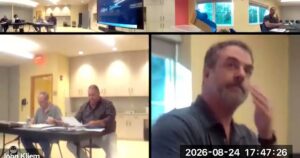
The Finance Committee on April 6 discussed with Planning Board Chair Anette Lewis why FinCom had previously voted 7–0 in favor of warrant article 25 (see story on page 5), which would increase allowable density to 32 units per acre and raise maximum building height to 58 feet within the Route 20 West Overlay Sub-District but then reversed their vote.
FinCom member April Methot said the committee had initially supported the article but later withdrew its recommendation after questions arose about whether existing projects, including Alta Oxbow, complied with underlying zoning standards for the Rivers Edge Housing Overlay. Methot said the lack of clarity prompted the committee to delay its position pending further information. The article had appeared to be standardizing zoning to match an existing real-world outcome.
Lewis explained that the proposed bylaw was never intended to reflect the built outcome at Alta Oxbow but was about making future projects legally compliant and feasible without requiring the risk of obtaining variances to build multi-family housing.
The comparisons to Alta Oxbow in Article 25 were based on the zoning requirements rather than the variances that ultimately allowed taller structures at that site, going from 45 feet to 58 feet in rear and changing the original Town Meeting approval of 190 to 218 units.
The specific standard for a variance used for Rivers Edge was that the topography was different than other lots in the district, however they were the only lot in the district which opened the town up potentially to a lawsuit. Also, the developers who obtained the River’s Edge parcel were part of a competitive bid but the bidding was based on what the zoning said, not on getting a variance on an issue the town could have been sued over.
She related in detail how the smaller Route 20 West parcels present physical and regulatory constraints, including lot size limitations, topography, and wastewater capacity, which would shape any future development proposals.
Lewis also explained that earlier modeling for the Sub-district, focused on compliance with state zoning requirements rather than economic feasibility. Subsequent analyses indicated that projects of 16 units or more face difficult financing constraints unless higher density and building height are allowed. She said the proposed increases would not require the town to redo state-required modeling because they expand, rather than reduce, allowable development capacity.
No vote was taken on Article 25, as the item was not on the posted agenda. Chair Carl Barnes said the committee would schedule a future meeting to consider both the article and a pending reserve fund transfer request.
During the April 6 Finance Committee meeting, Barnes reported that the town’s appeal for a zero-interest State Revolving Fund loan for its water infrastructure project had failed. He said the appeal did not result in any change to the project’s ranking or scoring, and town officials are now evaluating conventional bond financing and other options to fund the project.
The committee then turned to a discussion of its internal processes following the recent annual town meeting cycle. Members cited challenges managing both the operating and capital budgets and evaluating 52 warrant articles within unusually compressed timelines, with several noting that the workload detracted from detailed financial oversight. Member Bill Huss benchmarked their process against that of Lincoln’s FinCom which recommends the entire report, not individual articles, and only comments on articles important to pass in order to have a sound budget.
Member Iris Hoxha said the committee spent significant time drafting explanatory write-ups for non-financial articles, raising questions about whether that responsibility should fall to the Finance Committee. Others suggested that additional staff support could help assemble background materials and reduce administrative burdens, allowing members to focus on financial analysis.
Members also discussed the timing of budget review, noting that late delivery of capital and operating budget information limited their ability to fully evaluate departmental requests, in particular reviewing the school budget, which is the largest budget driver. Several proposed earlier engagement with department heads and a division of responsibilities among committee members to improve oversight.
The committee raised concerns about the volume and readiness of petitioner articles, suggesting that petitioners get earlier support in drafting and legal review would reduce confusion, multiple versions and last-minute revisions.
Multiple members announced that they are undecided or do not plan to continue on the committee after the current term. Former Chair Pam Roman had offered to fill a vacated seat until town meeting and will be stepping down. Chair Phil Giudice with a seat ending in 2027 said he has decided not to seek reappointment, while several others with terms expiring June 2026, including Barnes and Hoxha said they have not yet made final decisions. Methot will seek reappointment and Huss and Rob Quimby, whose terms end in June 2028, will return.
Members discussed the need to recruit new participants and suggested that changes to reduce workload pressures and increase staff support would improve retention.