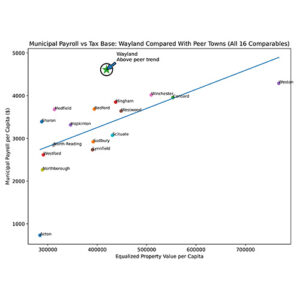
The Personnel Board on March 2 heard a presentation on a completed townwide classification and compensation study recommending a 16-grade pay structure aligned with Wayland’s continuing goal of paying at the 75th percentile of comparable Massachusetts communities.
The study, completed in February by consulting firm MGT Solutions, was funded through approval at the 2025 Annual Town Meeting. Katy Yee, project manager for MGT, presented the findings and described the study as a review of both internal equity and external competitiveness in municipal compensation.
Yee said the study had two major components: a classification review evaluating the relative responsibilities of positions across town government, and a market survey comparing Wayland’s pay structure to similar municipalities. She said the classification analysis used a point-factor methodology built on nine factors, including education, experience, decision-making, policy responsibility, planning, contacts, supervision, working conditions and use of technology. Employees completed job analysis questionnaires and supervisors provided comments, and MGT conducted interviews with at least one employee in each position studied.
The analysis included more than 100 positions and resulted in a recommended classification structure of 16 salary grades. The goal, Yee said, was to place positions from different departments into the same pay grades when their responsibilities were comparable, creating a consistent internal structure.
The compensation portion of the study compared Wayland with a set of similar municipalities using eight criteria, including population, per-capita income, equalized property value, tax levy, total municipal budget, state aid and geographic proximity. The analysis produced a peer group of 16 comparable communities. All but one municipality responded to the compensation survey.
The towns used for comparison include Acton, Bedford, Concord, Hingham, Hopkinton, Medfield, North Reading, Northborough, Scituate, Sharon, Sudbury, Weston, Westwood, Winchester, Westford and Lynnfield.
Pre-2019 Wayland operated around a mid-market, 50th percentile approach common for towns using older step-based systems. Under Town Administrator Stephen Crane departments struggled to compete for job applicants and though through budgeting and hiring decisions the administration adjusted to a more competitive target in the 75th percentile as reported in the 2022 study.
Yee said Wayland has targeted salaries at the 75th percentile of that market data, meaning the town aims to pay more than roughly three-quarters of its peer communities. Salaries are not 75% higher; it refers to ranking within the market.
She said the study found Wayland’s current pay ranges generally remain aligned with that target.
“That’s good news,” Yee said. “Your current salary ranges were keeping pace with the 75th percentile of the market.”
The proposed structure organizes the town’s positions into 16 salary grades with ranges designed to increase gradually between levels. Yee said the ranges were designed with an approximate 35% spread between minimum and maximum pay within each grade, which she said is common in municipal compensation systems.
The report recommends an “open range merit plan,” meaning employees move within salary ranges based on performance evaluations rather than fixed steps. The lowest grade would range from $33,000 to $42,900, while mid-level grades range from roughly $69,212 to $93,436 and $85,664 to $115,647. Higher administrative levels extend into ranges above $130,000 and $176,000, with the top grade reaching $220,000 to $297,000.
Board member Paul Morenberg asked whether towns sometimes target different salary percentiles for different job categories, particularly for hard-to-fill technical positions such as information technology roles. Yee said she had seen municipalities do that in limited cases but said MGT generally recommends a consistent target across all job groups to maintain internal equity and comply with equal-pay considerations. She said recruitment challenges can instead be addressed by hiring employees higher within an established salary range.
Board member Mary Ellen Castagno questioned how the board could evaluate the study without seeing actual employee salaries in the report and asked how stipends or additional benefit compensation would factor into the analysis. Yee said MGT evaluates base salary only so that comparisons across communities are consistent. She said actual salaries can vary widely because of tenure, step systems and other factors, which is why salary ranges provide a more reliable market comparison.
The report also reviewed employee benefits. According to the analysis, Wayland’s benefits are broadly comparable with those of peer communities in areas such as vacation time, sick leave and paid holidays. The town contributes about 74% of employee-only HMO premiums and 68% for family coverage.
Board member Jill Zukerman said she was interested in understanding where current employees fall within the proposed pay ranges and what the next steps would be.
Board Chair Maryanne Peabody focused much of the discussion on the financial implications of implementation. She asked how communities typically manage situations where some employees are paid well within or above the proposed ranges while others fall below the minimum.
Yee said the most common first step is to raise employees whose salaries fall below the proposed minimum range, since those employees may be under market levels. She said some municipalities phase in those adjustments over several years if budgets are constrained.
Other options include moving employees to the next step within a pay scale or freezing salaries that exceed the range maximum until the range catches up over time. Yee said communities generally avoid reducing salaries even if an employee’s pay exceeds the recommended range.
Town Manager Michael McCall said the study now presents a policy and budgeting challenge. He noted that multiple employee groups are governed by collective bargaining agreements, each with separate pay structures that could be affected by the study’s recommendations.
“It won’t be a one-size-fits-all rollout,” McCall said.
The town is currently finalizing its fiscal year 2027 budget after closing an estimated $1.8 million gap, while also dealing with winter snowstorm costs now over budget, he said. Those financial pressures, he said, will affect how quickly any compensation changes can be implemented and the town will likely examine a phased approach.
See the full study at tinyurl.com/WageCompRpt.