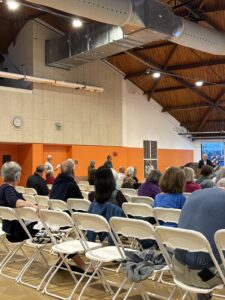
Town Meeting voters approved a major zoning change to allow larger multifamily development along Route 20 on Tuesday, overriding opposition from the Select Board, Finance Committee and Economic Development Committee in one of the most consequential and contested votes of the 2026 Annual Town Meeting.
The decision came after voters first moved quickly through a series of Planning Board articles, approving zoning updates and housing-related changes before turning to the more divisive Route 20 proposal.
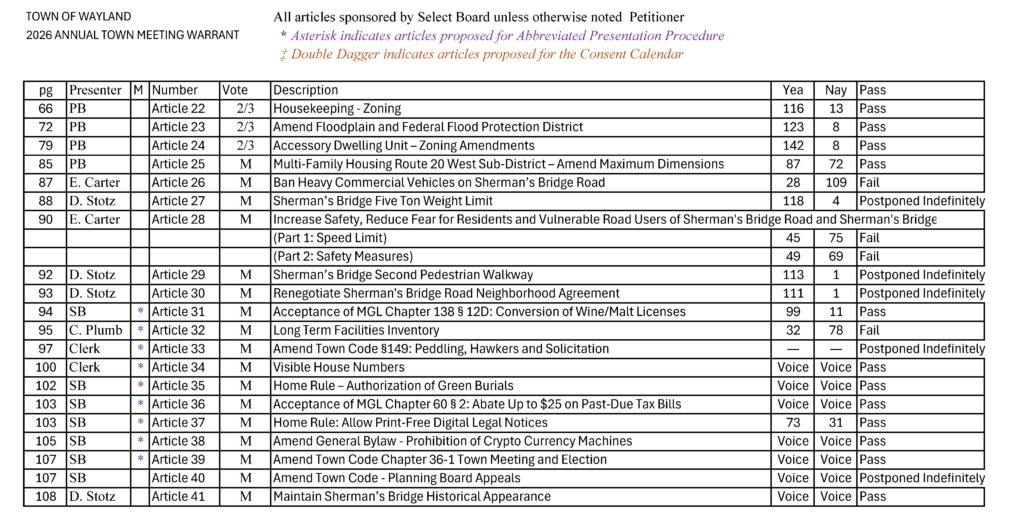
Article 22, a zoning “housekeeping” measure updating definitions and aligning bylaws with state terminology, passed 116–13 with limited discussion.
Article 23, which amended floodplain and federal flood protection district regulations to maintain compliance with FEMA standards, passed 123–8. Officials said the changes were necessary to preserve eligibility for the National Flood Insurance Program.
Voters also approved Article 24, revising accessory dwelling unit (ADU) regulations, by a vote of 142–8. The changes allow smaller ADUs by right while requiring special permits for units larger than 900 square feet or for multiple units on a property.
Speakers in support of Article 24 emphasized the need for flexibility to accommodate multigenerational living and aging in place, with residents describing the difficulty of designing accessible living space within the current size limits.
The meeting’s tone shifted with Article 25, which proposed increasing density and height limits in the Route 20 West multifamily housing sub-district. The measure passed 87–72, exposing a clear institutional divide between the Planning Board and several other town boards that urged delay and further study.
Planning Board Chair Anette Lewis said the changes were necessary to make development feasible under the state’s MBTA Communities law and pushed back on opposition arguments that relied on visual renderings of large buildings near the roadway.
Lewis said the Planning Board deliberately avoided adding detailed design restrictions to the zoning because doing so could violate state requirements and risk noncompliance with MBTA rules, which limit how much control municipalities can impose on multifamily districts.
Opposition, led by Select Board member Tom Fay, centered on both process and scale, emphasizing that multiple town bodies had reviewed the proposal and declined to support it.
“The Select Board voted two to three against supporting this article. The Finance Committee voted 1-3–2 against supporting it,” Fay said, adding that the Economic Development Committee had also raised concerns and recommended additional studies before moving forward.
Fay argued the proposal would allow building heights and massing that are inconsistent with the Route 20 corridor and said the town was acting without sufficient design safeguards.
Supporters also argued the location, an underdeveloped commercial area near the Sudbury line, was appropriate for increased density and could generate needed tax revenue with limited impact on residential neighborhoods.
The article passed by a simple majority.
Article 26, which sought to ban heavy commercial vehicles, was defeated 28–109 after town officials said the town lacked authority to impose such a restriction without state approval and coordination with Sudbury.
Town Counsel Carolyn Murray said the measure would be nonbinding and could not compel action by the Select Board.
Article 28, proposing a reduced speed limit and additional safety measures, failed in two parts, with votes of 45–75 on the speed limit and 49–69 on signage and crosswalk provisions.
Article 29, which proposed adding a second pedestrian walkway to Sherman’s Bridge, was indefinitely postponed, 113–1, without substantive debate.
Article 30, which sought to renegotiate the Sherman’s Bridge Road neighborhood agreement, was indefinitely postponed, 111–1, without substantive debate.
Later in the session, voters approved Article 31, allowing conversion of certain wine and malt licenses, 99–11, while rejecting Article 32, a proposal to create a long-term facilities inventory, 32–78, after officials said similar work was already underway.
Article 33, proposing updates to the town’s peddling and solicitation regulations, was indefinitely postponed following debate over whether the bylaw’s language was overly broad and could affect small-scale local activity.
Article 34, which requires properties to display visible house numbers to aid emergency response, passed by voice vote after brief discussion about how the requirement would apply to existing homes.
Article 35, which authorizes the town to pursue a home rule petition to allow green burials, passed by voice vote without discussion.
Article 36, which allows the town to forgive small past-due tax balances of up to $25 for administrative efficiency, passed by voice vote without discussion.
Article 37, which authorizes the town to pursue a home rule petition allowing legal notices to be posted digitally rather than in print, passed 73–31 after debate about access for residents without internet service and how notices would be verified.
Article 38, which bans cryptocurrency kiosks such as Bitcoin ATMs, passed by voice vote without discussion.
Article 39, which amends the town’s bylaws governing Town Meeting and election procedures, passed unanimously by voice vote without discussion.
Article 40, proposing changes to Planning Board appeals procedures, was indefinitely postponed after brief comment indicating the need for further review.
Article 41, introduced from the floor by Doug Stotz and calling for preservation of Sherman’s Bridge’s historical appearance, was passed over by voice vote.
The decisions left Wayland moving forward on housing expansion while deferring action on several smaller-scale proposals, reflecting a preference for broader policy shifts over piecemeal directives.