The River Stewardship Council has awarded a grant to document Henry David Thoreau’s Sudbury River today. Through three feature stories and a short documentary video, the Wayland Post will examine the transformation of the Sudbury River watershed and spotlight how its ecosystem and identity have changed since his journaling of the 1840s.
Wayland forms a piece of the eastern boundary of the 399-square-mile Concord River basin, also known as the Sudbury, Assabet and Concord (SuAsCo) watershed. The people involved, the dam, and the bridge names come and go over decades, but disputing over whether a river has a right to exist as its own entity or altered and marshalled as a resource for human drinking water, wastewater and economic development has not ceased. Locals have been arguing their beliefs about the value of a river in the SuAsCo watershed since colonial times.
The Sudbury River cannot be understood as an isolated local river confined to Wayland, Sudbury, or Concord in a watershed comprising 36 towns, of which 21 have waterfront land along the river corridors. There are 12 major tributaries to the Sudbury River — the Eames, Cochituate, Cranberry, Hop, Indian, Pantry, Pine, Rutters, Stony, Trout, Wash, and Whitehall brooks — which have assorted small dams. On the main stem of the Sudbury River, upstream of the Wild & Scenic segment, there are seven dams plus two large MWRA reservoir dams in Southborough.
The control over rights to rivers and wetlands are arguably the most contentious environmental issue in the United States with respect to the conflict between public and private property rights at the local, state and federal levels. Hard-fought legal battles drive explicit and standardized legal regulations over the identification, delineation and ownership of river water, riparian land, and wetland ecosystems.
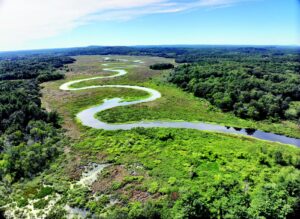
The 33-mile-long Sudbury River runs from its headwaters in the Cedar Swamp in Westborough, just west of the I-495 and U.S. 90 interchange, eastward to Saxonville in Framingham and then north to meet at the confluence with the Assabet River to form the Concord River. Westborough has the unusual distinction of containing the headwaters of both the Sudbury and Assabet rivers. The Sudbury River starts 20 feet lower and south of the Assabet River.
The Sudbury River comprises much of Wayland’s western border, as historical Sudbury split over the problems about crossing the river to get to church. East Sudbury was incorporated in 1780 and renamed Wayland in 1835.
In 1999 the town was fortunate to have in its backyard 12.2 miles of the 16.6 miles of the Sudbury River designated as federal Wild and Scenic River. A total of 29 miles in the SuAsCo watershed was protected including 4.4 miles of the Assabet River and 8.0 miles of the Concord River. A federal agency cannot recommend authorization of a water resources project that would have a direct and adverse effect on the “outstandingly remarkable values” for which a Wild and Scenic River was designated.
Henry David Thoreau, born in 1817, was the first to record the life and phenology (the study of periodic, cyclical events in biological life cycles and how they are influenced by climate and seasonal changes) of the three rivers of the SuAsCo watershed in detail by western scientific methods. Until his death in 1862 at 44, Thoreau recorded almost daily the physical changes in and around the three rivers where he regularly rowed, sailed, walked, skated or worked. He spent more of his lifetime on the three rivers than he did living on Walden Pond. Starting with the observations in his journals, SuAsCo watershed has become the most studied river ecosystem over time in Massachusetts.
From his compiled seasonal data, Thoreau came to understand the river ecosystems based on geography and geology without the benefit of the yet-to-be discovered science of plate tectonics. He also deduced the functioning of the watershed as an ecosystem, an idea unknown at the time.
His writings today provide the basis of the history of the transitions from minimally exploited forest to agriculture to industrialization by canals and railroads on the water cycle and the watershed ecosystem. That knowledge continues to be expanded upon by today’s residents concerned about the effects of suburban expansion.
Look for the upcoming articles that will cover the uniqueness of the Sudbury River ecosystem and how the life of the river and life of the people, flora and fauna that rely on it are deeply intertwined. You may be surprised at how much Wayland residents of today are a part of the ongoing story of the Sudbury River and why you want to go visit it in person.