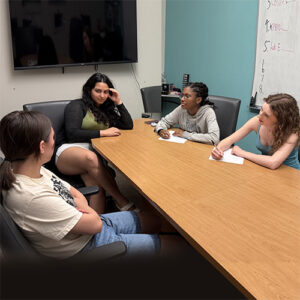
At Wayland High School, trained student peer mediators help their classmates resolve an array of conflicts. Next year, the Peer Mediation program will expand and become a course.
Under the leadership of Assistant Principal Sean Gass and counselor LaToya Downes, the peer mediators will have more dedicated time in the school schedule for mediation.
Gass knew a colleague who used a peer mediation program on the North Shore and he was interested in learning more about the program. He was referred to Metrowest Mediation Services (MWMS), which helped establish the program and provided the training sessions for the student mediators. The company has worked with Framingham and Natick public schools and the Advanced Math and Science Academy in Marlborough.
Seth Izen, executive director of MWMS, lauded Gass for his work in the program and its growth at WHS.
“Because peer mediation is not yet the norm in most schools, it takes visionary school leaders who are willing to empower students to help resolve conflicts among their peers,” Izen said. “I’m grateful that Principal [Allyson] Mizoguchi and Assistant Principal Gass recognize the value of peer mediation and its ability to strengthen school culture by giving students meaningful leadership opportunities and helping address conflicts before they escalate.”
Izen explained that most mediations happen between students who feel uncomfortable and don’t know what to do about it. Mediation is often requested for offenses that do not rise to the level of school suspensions or discipline. These situations may involve two students who used to be friends and have had a falling out, negative comments on social media, or rumors from an ex-boyfriend or girlfriend after a split. The problem could also pertain to a fight that happened out of school. Such scenarios may prevent students from concentrating in school or focusing on their studies.
“When I joined Peer Mediation, I didn’t realize how much it would help the students, as well as myself,” said Katelyn Collett, a junior. “The process simply guides the students to a solution without any biased input.”
A shift in Massachusetts law requires schools to seek alternative strategies before suspending students. Mediation provides different strategies for students and allows them to address problems face to face. Gass said there are currently 24 student mediators (who are recommended by staff) and four adults at WHS who are trained in peer mediation, and he estimated that 10 to 15 mediations occur each year. Certain times of the school year may be busier than others, like the end of winter or around more stressful times like during exams, he added.
Mediation, which is voluntary, has greatly changed the way he looks at discipline, Gass said.
“Discipline has changed quite a bit. Peer mediation is a regular practice for us now,” he said. “Before we look at any disciplinary actions, conflict can be discussed, mediated, and resolved before it becomes explosive, physical or gets in the way of learning.”
Gass joked that mediation works even when it doesn’t. He told the story of two friends who were not getting along and participated in mediation. Slowly, he noticed some changes; the students began sitting closer together at lunch, and a week later, he noticed them talking again. When he asked them separately if they thought that mediation session had worked, they both said no — but as the year progressed their actions said otherwise.
“Through my journey as a peer mediator, I’ve been surprised by how often people don’t need someone else to solve their problems,” said sophomore James Morris. “They just need the space to work through it themselves. This program has helped me develop the tools to create that space, and I believe that’s something I’ll carry far beyond high school.”
The program faced some skepticism in its first year, but since then, there’s been a shift — peer mediators have a sense of pride in helping and the meetings provide all participants a great life skill, Gass said. Mediation allows students to “take a breath and listen and open their minds a lot,” he added.
Outside of school, Gass is also certified as a court mediator, which he said helps sharpen his skills at school.
MWMS works with other organizations in addition to schools and assists in court with issues between tenants and landlords or in private companies where there may be disputes between two employees.