The audience was transported back to April 10, 1946. Sitting in the community room of First Parish Church on Boston Post Road, they were anxiously awaiting the arrival of Frances Perkins, the first woman to serve as Secretary of Labor in President Franklin Delano Roosevelt’s cabinet. They were eager to hear how she played an instrumental role in Wayland’s construction projects, which were part of FDR’s Works Progress Administration (WPA).
Roosevelt’s WPA employment program was introduced in 1935 as part of the New Deal to combat high unemployment during the Great Depression. The WPA, along with earlier programs like the Civilian Conservation Corps (CCC) and Civil Works Administration (CWA), employed millions to build infrastructure, schools, and parks, providing crucial “work relief” rather than direct cash handouts. Perkins was a key architect of the New Deal, playing a central role in creating major jobs programs. She helped design, authorize, and oversee the WPA, ensuring its focus on employment, infrastructure, and worker protections.
Some of the Wayland WPA projects were the new Town Hall building, upgrading the 1841 Town Hall on 42 Cochituate Road, building Dudley Pond Beach, improving schools and infrastructure by widening and improving numerous roads, such as Hazelbrook Lane, Rice Road, Stone Bridge Road, Pelham Island Road, and Oak Street. Water pipes were laid on Stanton Street, Harrison Street, Dunster Avenue, Old Connecticut Path, and Sycamore Road.
“A Living History Presentation: Frances Perkins: A woman’s work” was presented on April 10 as part of Wayland’s Rev250th Celebration, sponsored by the Wayland Historical Commission and First Parish Church.
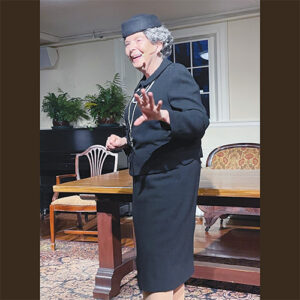
Entering the room, the 66-year-old Perkins, dressed in a tailored blue wool suit, felt hat, and sensible shoes, walked confidently to the front of the room and began to narrate her life story. She was born in Boston as Fanny Coralie Perkins and grew up in a middle-class Republican family in Worcester. Her family owns Perkins and Butler, a paper, twine, and stationery shop. According to Perkins, her father, a big proponent of education, encouraged her to attend college. She graduated from Mount Holyoke College in South Hadley, and later attended the University of Pennsylvania and Columbia University, where she studied economics and sociology, respectively.
Perkins said she worked as a teacher in New Hampshire and Illinois, but left education because she felt “a calling to strive to change working conditions” and felt that it was “up to me” to address the hazardous conditions and poverty she witnessed. After graduating from Columbia in 1910, Perkins was hired as the executive secretary of the New York Consumers League, where she investigated industrial conditions and lobbied for a 54-hour workweek. Through political networking, she met Al Smith, who would become governor of NY, FDR, and her husband, economist Robert Wagner, who later became secretary to the NYC mayor in 1913.
Perkins described her initial thoughts about FDR in their first meeting. Lifting her eyes upward, she described the young, privileged attorney as “arrogant” and “artificial.”
Perkins attributed the New York Triangle Shirtwaist Factory fire on March 25, 1911, as the defining moment in her life, shifting her from a social researcher to a reformer. With a crack in her voice and watering eyes, she described watching young workers, mostly immigrant women, jumping from the 9th floor of the Asch Building because they had no other way to escape the building. The factory owners had locked them in the building.
When FDR became governor in 1929, he appointed her to the Industrial Commissioner, and after winning the presidency, he appointed her as U.S. Secretary of Labor (1933-1945). She was the longest-serving Secretary of Labor and focused on economic security during the Great Depression. With a smile on her face, Perkins quoted FDR, saying “never underestimate the women’s vote,” after Herbert Hoover, running for president, said he would appoint his labor secretary from the ranks of organized labor. This drew cheers from a male crowd, she said, but he lost the election.
Perkins said she “went to Washington to work for God, FDR, and the millions of forgotten plain common workingmen.”
Standing up straighter with pride in her voice, she described the achievements that she and FDR succeeded in making: the Social Security Act in 1935, fair labor standards in 1938, the Civilian Conservation Corps, workplace safety and standards, and immigration support protection for refugees fleeing Nazi Germany.
With concern and dread in her voice, Perkins described how she was called in 1939 before the House Un-American Activities Committee and why the House of Representatives tried to impeach her. Both groups alleged that she was a communist because she had raised funds for Jewish children in Nazi Germany. They said that she was born in Russia because they could not locate any birth records for her. (She had changed her name from Fanny Coralee.)
There was sadness in her voice and on her face when she explained that her career ended abruptly when FDR died at the beginning of his fourth term. She had come to admire FDR. She said that he changed after he contracted polio. He became more empathetic. She also lamented that they were unable to introduce their plan for National Health Care in FDR’s fourth term. “There was a plan in his desk drawer,” she said.
Although she said she offered to remain in her position, after FDR died, Truman said he had someone else in mind and appointed her to the U.S. Civil Service Commission, which she served for seven years. She ended her presentation with encouraging words, “Be not afraid, do what you can.” After she finished her presentation, Perkins answered the audience’s questions. It was evident from their questions, Jarice Harrison had succeeded in resurrecting the spirit of Frances Perkins.
Returning to 2026, Hanson answered questions about Perkins and her own work. After leaving the U.S. Civil Service Commission, Perkins became a renowned lecturer and teacher at the Cornell University School of Industrial and Labor Relations, authored the influential book ”The Roosevelt I Knew” (1946), and continued to promote public service until she died in 1965 at 84.
Hanson is a retired professor from UMass Amherst and a member of Actors’ Equity Screen Actors Guild. She was inspired to take on the role of Frances Perkins when Mount Holyoke College invited her to assume the role when another actress canceled her college event performance. Looking around the campus, Hanson said, Perkins became a reality to her. She decided to explore the role further. She visited the Frances Perkins National Monument located in Newcastle, Maine, which is the 57-acre saltwater farm owned by the Perkins family for 270 years. Hanson met Tomlin Perkins Coggeshall, Perkins’ only maternal grandson. He died in 2025. Hanson said she confided her concern about portraying his grandmother accurately. His response was “Go for it,” according to Hanson
Hanson said she travels around the country with her one-woman show. She excitedly said she will be speaking at the American Association of University Women’s convention this year in Colorado, where Perkins delivered a speech to this group in 1939. In that speech, she highlighted the role of women in government and advocated for key New Deal policies.