By Marina McAlpine
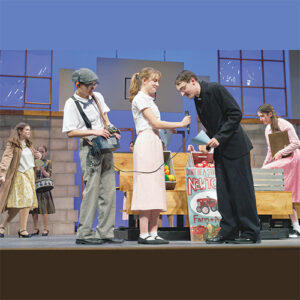
The Wayland High School Theater Ensemble (WHSTE) is earning recognition across the state after advancing to the finals of the Massachusetts Educational Theater Guild Festival with their unique, student-devised production of “To Parents and Other Neighbors” that is rooted in local history.
Unlike traditional school plays, which typically begin with a finished script, this production was created collaboratively by the cast and directors over a several-month span. Co-director Aidan O’Hara, who worked alongside fellow director Ryan Watts, described the show as “devised,” meaning the students themselves played a central role in shaping the story, characters, and dialogue.
The inspiration for the production came from a surprising historical source: a letter written in 1954 by Anne Hale, a Wayland teacher, to her students, originally published in the town’s newspaper, The Town Crier. From that starting point, the cast began an open-ended creative process.
“We started this process with a prompt of a moment in Wayland history, the story of Anne Hale’s dismissal as a teacher at Center Elementary in Wayland during the Red Scare and McCarthyism,” said Ruth Flacke, a drama student. “From there we spent December and January doing a series of improvised scenes, character work, long-form improv, physicality work and many other activities to develop characters and storyline.”
“Every rehearsal was sort of cyclical,” O’Hara explained. “We would devise scenes based on prompts or questions, and that helped generate ideas about character and plot.”
Early rehearsals focused on exploration, allowing students to experiment freely before narrowing their focus to specific storylines and character arcs.
Flacke emphasized how engaging that early process was for the cast.
“I think everyone found this part of the process to be really rewarding and very exciting,” she said. “It is pretty cool to come to rehearsal with your friends and be creating a show from scratch.”
She described how collaboration was built into rehearsals through small group work. “Oftentimes, the cast would split up into groups of 4–5 and would be given a simple prompt,” Flacke said. “The groups would then work together to create a scene and swap ideas.” These exercises helped students build both the narrative and their teamwork skills.
By December and January, the ensemble had developed enough material to begin shaping a formal script. The final production featured 19 students, all of whom contributed to the writing process and were ultimately cast in the show. After the script was finalized, the group shifted gears toward staging and performance, preparing for competition.
That preparation paid off. WHSTE entered the preliminary round of the statewide drama festival on Feb. 28, joining approximately 100 schools competing against each other. Two weeks later, the ensemble advanced to the semifinals, narrowing the field to 42 schools. Most recently, they secured a spot among the final 15 schools that performed in Boston Mar. 26-28.
For many students, the festival, which is not like a typical competition, itself is one of the most memorable parts of the experience.
“The best part of the Winter One-Act is when we get to share it at the METG,” Flacke said. “Festival allows us to make friends from across the state and see other incredible shows.
“One of my favorite parts is the energy in the room when there are 8, or 15 at finals, schools in the theater who all appreciate theater and can’t wait to see each other perform.”
While the competition is intense, the director emphasized that the experience goes beyond winning. A key element of the festival is what participants call the “Spirit of Festival,” which encourages collaboration, appreciation, and connection among students from different Schools.
“It’s really affirming for students to meet other theater kids and share in that experience,” O’Hara said. “There’s a lot of support for each other’s work and an appreciation for different kinds of performances.”
The festival culminates in an awards ceremony recognizing standout performers and technicians, as well as announcing which productions advance. Still, for many students, the relationships and shared passion for theater are just as meaningful as the results.
What sets Wayland’s production apart is not just its collaborative creation, but its deep connection to the local community. Many of the characters portrayed in the play were based on real people from Wayland’s past, with roughly two-thirds drawn directly from historical figures.
“There were people in the audience who remembered these figures [in the play],” O’Hara said. “For the students, bringing real members of their community to life was a really meaningful experience.” The production also included “home” performances for local audiences, further strengthening that bond between the students and the town’s history.
“It was powerful to start with a piece of Wayland history,” O’Hara said, “and create something about the community we live in.”
With a finals appearance now under their belt, Wayland High School Theater Ensemble continues to demonstrate the creativity, dedication, and community spirit that define student theater at its best.